- ATAR Digest
- Posts
- ✍🏻 How to Study Effectively
✍🏻 How to Study Effectively
These methods got me a 95+ ATAR

Luqman Arab
April 21, 2024

Do you feel like you’re just ‘bad’ at doing exams?
Have you ever walked into an exam before, felt like you were going to smash it, yet when you got your results back you were shocked…
Or perhaps you feel like you study so hard…but your results just don’t reflect it.
Well, if that’s the case, you’re most likely studying completely wrong.
And honestly, I don’t blame you. Our schools don’t teach us how to study. They don’t teach the ‘what’.
We then get tutors to further teach us the ‘what’….but where’s the ‘how’?
So, in today’s newsletter I am going to finally reveal to you how to effectively study like a 95+ ATAR student.
What I will be revealing to you in today’s post literally got me a 95+ ATAR…so take this stuff seriously!
If you’d like to watch the video version of this newsletter post, you can do that here:
Just a reminder though:
Knowledge is not power, it's potential power. It only becomes power when you use it.
Table of Contents
🧠 Types of Studying
There are two ways you can study:
Passive studying
Active studying
Passive studying involves putting information into your brain.
Requires no effort. Doesn’t really use your brain.
Examples include: taking notes, highlighting, rereading.
Passive studying is what we are taught in schools.
‘Make sure you take good notes.’
‘Read your textbook well before your exams’
This is how the majority of students study, and why the majority of students don’t perform well!
Active studying involves taking information from your brain. In other words, retrieving it from memory.
Requires effort. Your brain is being engaged.
Examples include: questions and summarising from memory.
💯 The Most Effective Study Methods
There are many study methods out there that are effective. However, I’ll reveal to you the top 3 that I use:
Active Recall
Involves actively recalling information from memory, rather than passively reviewing or rereading the content.
This technique is hard and uncomfortable, which is why I’ve had some students give up after 2 weeks of using it!
This is what happens after using active recall:
Information in short-term memory transfers to long-term memory
Knowledge consolidates
How to apply active recall:
Generate questions from your notes to test yourself on.
Summarise notes from memory
Feynman technique — act like you’re teaching the content to a 5 year old by speaking aloud without referring to notes
Spaced Repetition
Spaced repetition refers to reviewing the content [after first learning it] multiple times over set intervals.
This method beats something called the ‘forgetting curve’, allowing you to remember the content for long periods of time.
Refer to 4:00 in this video to see an in-depth explanation: https://www.youtube.com/watch?v=_3jqCebrFxo
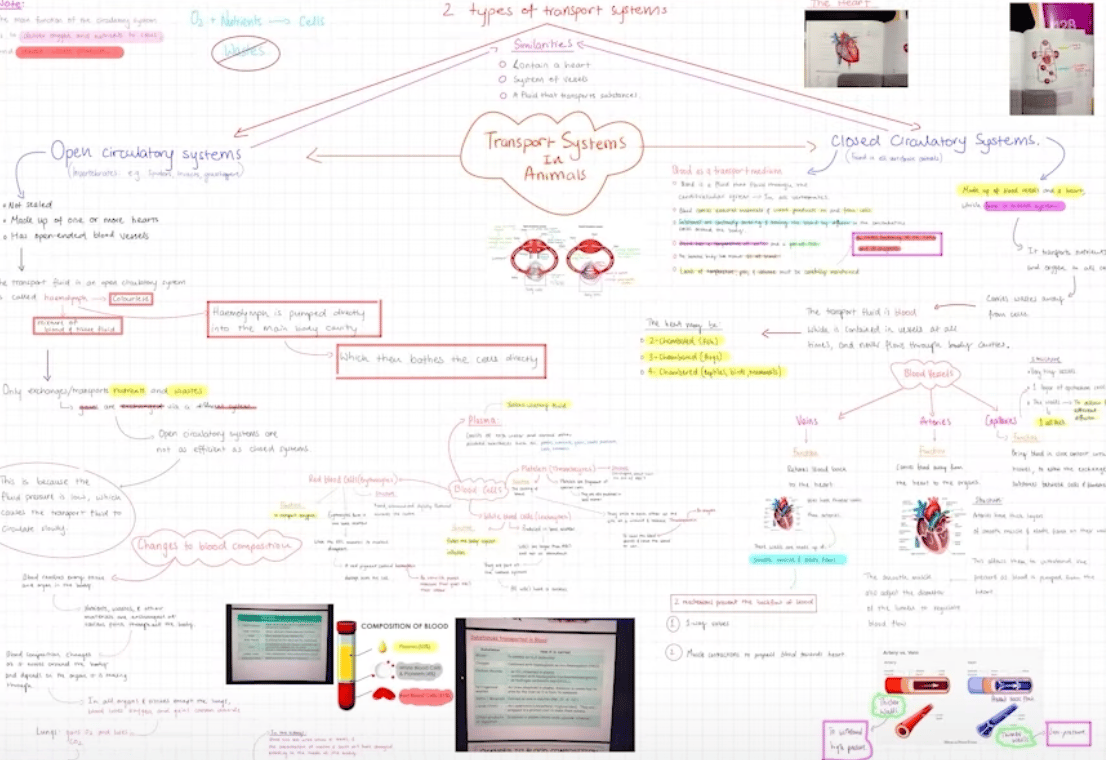
Mind Mapping
Mind mapping involves visualising how different topics relate to each other and the connections between them.
This method is amazing for visual learners (like myself), and helps with deepening your understanding of the topic.
Here’s an example of my year 11 biology mind map:
📝 The BEST Study Method
Active recall, spaced repetition and mind mapping are all great methods. They are especially useful for first understanding, learning and memorising the content.
But do you know what the BEST study method of all is?
PAST PAPER EXAMS / PRACTICE QUESTIONS!
Think about it, you’re preparing for an exam. So, logically, the best way to prepare is to replicate an exam.
Make sure you are doing a bunch of past papers and practice questions. I cannot stress this enough.
If you haven’t already, I’d suggest you read my short ebook on how to effectively do past paper exams. In this book, I teach you my 6 step formula for maximising all the papers you do.
✏️ Notes vs. No notes?
Ultimately, this depends on you.
Taking notes is fine as long as you understand what the notes are for.
Your notes are simply for organising the information and making sure that you’ve addressed all the points of the syllabus.
That’s it.
After you’ve taken those notes, don’t ‘study’ by rereading them or rewriting them.
Apply the methods above.
If you do this, you’ll be able to effectively use your notes to smash exams!
✅ Action Steps for the Week
Stop studying passively.
Use active recall when you study — generate questions from your notes, summarise them from memory or teach it.
Use spaced repetition — review your content over set intervals of time.
Do past papers or practice questions!
🥇 Join the DUX Club!
The DUX Club is a community of 130+ dedicated ATAR students who are hungry for success.
This is a community I’ve recently created…and it’s for free.
What’s inside?
✅Valuable 95+ ATAR courses that teach you the skills your school doesn't! (COMING SOON)
✅Supportive, non-toxic community of like-minded students
✅Motivation and Inspiration from a student who went from getting D's to straight A's
✅Weekly 95+ ATAR tips and challenges to level you up as a student
✅Live Q&A Sessions that offer personalised guidance & support
✅Accountability to make sure you get things done
How do you join?
Click on this link 👉️ https://www.skool.com/the-dux-club-4750/about
Click ‘Join Group’
Make an account
You’re in!
Students are already leveling up in the DUX Club: